

You wrote yourself a cheque from the company account in March. Maybe it covered a family vacation, a down payment, or another personal expense. Nothing about that transaction felt like a tax event. But unless the payment was properly recorded as salary, a dividend, repayment of an amount the company owed you, or another legitimate corporate transaction, it may be sitting on your books as a shareholder loan. And the Canada Revenue Agency started a clock the moment the money left the corporate account.
If you read our earlier article on what a shareholder loan is, you already know that money you take out of your corporation without a proper characterization may be recorded as a loan from the company to you. Not every withdrawal lands there. A reimbursement of a valid business expense, repayment of funds you previously lent the company, or properly authorized rent or interest owed to you are different transactions with different treatment. But when the books show a loan, the rule that determines whether it stays a loan or becomes taxable income is the one-year repayment rule under subsection 15(2) of the Income Tax Act.
What is the CRA one-year rule?
Here is the rule in one sentence: a shareholder loan must generally be repaid within one year after the end of the corporation’s taxation year in which the loan was made, and the repayment cannot be part of a series of loans and repayments, or the amount that remains unpaid is generally included in your personal income for the year you borrowed it.
Notice the wording. The deadline is not one year from the date you took the money. It is one year from the end of the taxation year in which you took it. That distinction changes your actual repayment window considerably.
An example with real dates. Your corporation has a December 31 year end. You draw $40,000 in February 2025. The taxation year containing that draw ends December 31, 2025. You have until December 31, 2026 to repay. That draw in February gave you nearly 23 months.
Now flip it. You draw the same $40,000 in November 2025. Your deadline is still December 31, 2026, but now you have only 13 months. The timing of the draw within your fiscal year quietly determines how much runway you get, which is one reason a quick conversation with your accountant before a large draw is worth the phone call.
What happens if you miss the deadline?
The consequences compound, and they reach backward in time. If the loan is not repaid by the deadline:
- The full loan amount must be included in your personal income for the year you received it, not the year the deadline passed. If that return was already filed without the inclusion, you may need to amend it, or CRA may reassess it.
- Arrears interest generally accrues from the balance-due date for the affected personal tax year. For most individuals that is April 30 of the following year, though different balance-due rules can apply in some situations. For July 1 through September 30, 2026, CRA’s overdue-tax interest rate is 7%, compounded daily. The rate resets quarterly, so confirm the applicable rate for each period using the prescribed interest rates published by the CRA.
- The income arrives without the usual offsets. A subsection 15(2) inclusion is often less tax-efficient than a properly declared salary or dividend, because it generally carries no dividend tax credit and gives the corporation no salary deduction.
Business owners sometimes treat the shareholder loan account as a flexible line of credit. The one-year rule is intended to prevent shareholders from using corporate funds as an indefinite source of personal, untaxed financing. One partial silver lining exists: if a loan that was previously included in your income under subsection 15(2) is later genuinely repaid, you may generally claim a deduction under paragraph 20(1)(j) in the year of repayment, provided the repayment is not part of a prohibited series. That can soften the eventual tax cost, but it does not reverse the earlier assessment or generally recover the arrears interest that accumulated. Our article on avoiding CRA penalties and interest covers how quickly daily-compounding charges add up.
Can I briefly repay the loan and then borrow the money back?
Usually not as a deadline-management strategy. The Income Tax Act contains an anti-avoidance provision for what it calls a “series of loans or other transactions and repayments,” and CRA examines all the facts. If you repay the corporation shortly before the deadline and then borrow substantially the same amount back, especially where the later corporate advance effectively funded the repayment, the repayment may be treated as part of a series. In that case the one-year exception does not apply and the original loan goes into your income.
This is a facts-and-circumstances test, not a blanket ban on ever borrowing again. CRA specifically accepts that repayments made by applying genuine dividends, salaries or bonuses against the loan are not part of a series merely because you borrow again later. Repayment can legally occur through cash, transferred property, a valid legal set-off, or the application of amounts the corporation properly owes you. What CRA rejects is a repayment that exists only to reset the clock.
How do most owners actually clear the balance?
In practice, the cleanest fix is to declare compensation and legally apply it against the outstanding balance before the deadline. Your accountant can:
- Declare a bonus or salary, which the corporation deducts and you report as employment income, or
- Declare a dividend, which you report at dividend tax rates with the dividend tax credit.
Either route can retire the loan, provided the compensation is validly authorized, properly documented, and actually paid or applied against the loan balance as a legal set-off. Salary and bonuses also carry payroll obligations: source deductions must be withheld, reported and remitted. Accounting entries alone do not decide the tax result; the underlying legal transaction does. Which route makes sense depends on your income level, your corporation’s tax position, and your CPP and RRSP planning. We walk through that decision in our article on salary vs. dividends.
One timing note on bonuses. A year-end bonus may generally remain deductible to the corporation if it is paid within 180 days after year end. That rule governs the corporation’s deduction, not your loan. Merely declaring a bonus does not repay the shareholder loan; the bonus must be validly payable and actually paid or legally applied against the balance, with the appropriate payroll deductions and remittances handled along the way.
Don’t forget the interest benefit while the loan is outstanding
Even a loan that will be repaid on time carries a second, smaller tax consequence. If your corporation charges you less than the CRA prescribed rate, the difference is a taxable benefit under section 80.4 of the Income Tax Act. For July 1 through September 30, 2026, the prescribed rate for shareholder and employee loan benefits is 3%. Because the rate resets quarterly, a loan outstanding across quarters may require the benefit to be calculated using more than one rate. If the prescribed rate remained at 3% for the entire year, a $50,000 interest-free loan outstanding all year would create a benefit of approximately $1,500.
To reduce or avoid the benefit, the corporation charges you at least the prescribed rate, and you pay that interest no later than 30 days after the end of your tax year. For an individual with a calendar tax year, that works out to January 30 in practice.
Are there exceptions to the one-year rule?
Yes, but they are narrow and they hinge on employment. Subsection 15(2.4) allows longer repayment terms for certain loans where the borrower is an employee of the lending corporation or a related corporation, the loan fits a statutory category, it is reasonable to conclude the loan was made because of the employment rather than the shareholdings, and bona fide repayment arrangements are established within a reasonable time when the loan is made. The main categories:
- A dwelling for the use of the employee or certain related persons
- An automobile used in performing employment duties
- Previously unissued shares purchased from the corporation or a related corporation
- Certain loans to an employee who is not a specified employee, meaning, broadly, not a major shareholder
These exceptions are audited carefully. The “because of employment, not shareholdings” test is where owner-managers most often fail, since a 100% shareholder has a hard time showing an interest-free housing loan was an employment perk rather than a shareholder benefit. They are not a workaround to plan around casually.
What good record keeping looks like
The one-year rule punishes sloppy systems more than it punishes borrowing. Owners who get reassessed usually did not set out to break a rule. They took draws throughout the year, nobody tracked the running balance, and by the time the year-end file landed on an accountant’s desk, the deadline math was already tight. A few habits close that gap:
A written loan agreement at the time of any significant draw. A running shareholder loan ledger in your books, reviewed at every year end. Interest actually paid, not just accrued, within 30 days of year end. And a plan, made early, for how the balance will be cleared.
If your bookkeeping is current, the shareholder loan balance is never a surprise. If it is not, the balance tends to surface exactly when the repayment window has nearly closed.
Grab the one-page cheat sheet
We condensed everything above into a single reference: the deadline timeline, what happens if you miss it, and the five habits, all on one page.
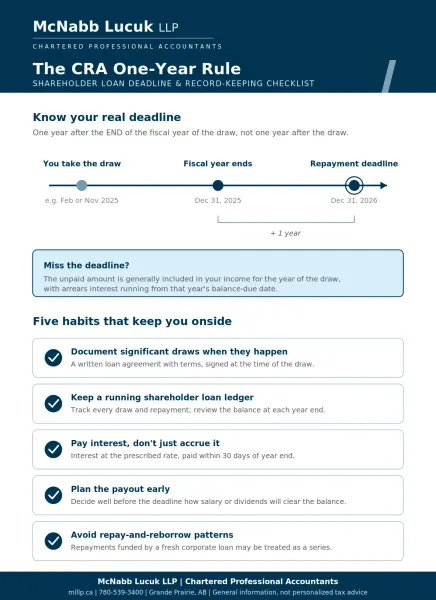
Print it, pin it above the desk where the cheques get written, or share it with a business partner who still treats the company account as a personal one. Download the PDF version here for a clean printable copy.
Frequently asked questions
Does the one-year rule apply to small amounts? Yes. Subsection 15(2) has no minimum threshold. A $3,000 draw follows the same rules as a $300,000 draw.
My spouse took the draw, not me. Does the rule still apply? Potentially. Subsection 15(2) also covers certain persons connected with a shareholder, which commonly includes a spouse or common-law partner and may include other persons who do not deal at arm’s length with, or are affiliated with, the shareholder. The exact relationship and circumstances should be reviewed.
Can the corporation just forgive the loan? Forgiving the loan generally does not eliminate the tax problem. The forgiven amount may be included in your income as a shareholder benefit.
What if I repay part of the loan by the deadline? Generally, only the portion that remains unpaid at the deadline is included in income, provided the repayment was genuine and not part of a series of loans or other transactions and repayments. CRA generally applies repayments against the oldest outstanding amounts first.
Where can I read the actual legislation? The full text of subsection 15(2) is available through the Department of Justice.
Get ahead of the deadline
The one-year rule rewards owners who plan their draws and punishes owners who discover the balance in April. If you have taken money out of your corporation this year and are not sure where your shareholder loan account stands, contact McNabb Lucuk LLP at 780-539-3400 or [email protected]. We will review the balance, map the repayment deadline against your fiscal year, and structure a properly documented salary or dividend plan that clears it before the CRA does the math for you.
This article provides general information and does not replace personalized tax advice. Rules and prescribed rates change; confirm current figures with the CRA or your accountant.